SECTION 04 // ERGONOMICS, TEXTILES & TELEMETRY

The Cabin Reimagined

Where the driver’s hands, eyes, and posture meet the build: examining seat geometry, heritage fabric weaving, bespoke joinery, and non-intrusive instrumentation.

EXPLORE CABIN SUBSYSTEMS
TOUCHPOINTS // THE THREE PRIMARY INTERFACES

Steering Rim, Seat Bolster & Shifter Gate

ERGONOMIC TRIANGLE

While exterior bodywork addresses the spectator on the pavement, the cabin belongs entirely to the driver and passengers. Across Asia’s premier interior trim shops—from Osaka and Aichi in Japan to Bangkok and Kuala Lumpur—the prevailing design philosophy has moved sharply away from the fibreglass speaker enclosures and neon acrylic panels of the early 2000s. In their place is a quiet, tactile discipline centered on the "ergonomic triangle": the spatial relationship between steering wheel rim, seat hip-point, and gear lever.

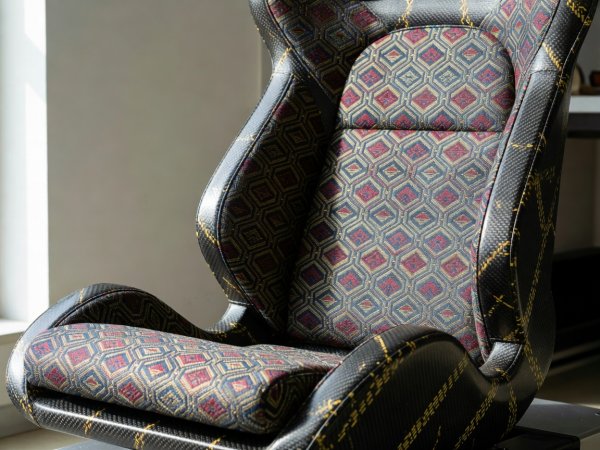
Textile selection plays a central role in this evolution. In humid subtropical and equatorial climates, non-breathable vinyl and heavily coated leathers trap heat. Trimmers increasingly specify perforated vegetable-tanned hides on outer wear bolsters paired with woven center cushions. In Japan, collaborations between seat manufacturer Bride and regional artisans incorporate Nishijin-ori—the centuries-old Kyoto silk-and-metallic-thread brocade tradition—woven into high-abrasion automotive backing cloth. Similarly, builders in Malaysia and Thailand commission hand-dyed indigo kasuri cottons and breathable 3D-spacer meshes that keep the cabin cool after hours parked under tropical sun.

Even utility vehicles receive architectural interior overhauls. Japan’s booming Shachuhaku (overnight car-camping) movement has turned 660 cc Kei micro-vans and Toyota HiAce commuters into mobile timber-lined studios, utilizing lightweight paulownia (Kiri) and Japanese cypress (Hinoki) cabinetry attached via factory threaded cargo tie-down points so the entire camper module can be unbolted in under an hour.

Natural-light photograph of a carbon-Kevlar bucket seat trimmed with woven Kyoto geometric brocade center cushions SEATING // KEVLAR & BROCADE

Composite Shells with Split-Thigh Support

Autoclaved carbon-aramid seat shells weigh as little as 5.8 kg while utilizing split front cushions that allow independent left-leg clutch articulation in manual-transmission builds.

CERTIFICATION: ASEA / JIS D 4604 | SHELL: CARBON-ARAMID
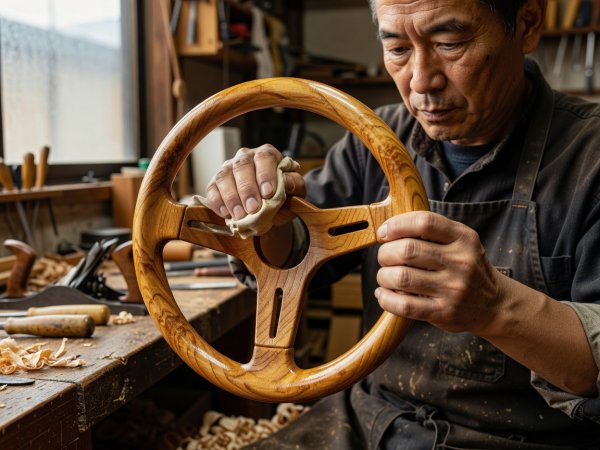
Woodworker hand-rubbing oil finish onto a small-diameter Japanese zelkova wood steering wheel with three slotted spokes CONTROLS // 330 MM WOOD & SUEDE

Turned Hardwood & Chamfered Aluminum

On pre-airbag classics, builders fit 330 mm to 350 mm steering wheels crafted from laminated Japanese Zelkova (Keyaki) or walnut with CNC-chamfered duralumin spokes.

DIAMETER: 330–350 MM | DISH DEPTH: 35 MM TO 75 MM
CABIN SUBSYSTEM ACCORDION // DETAILED SPECIFICATIONS

Examine Interior Engineering Layer by Layer

KEYBOARD ACCESSIBLE PANELS

Modern engine swaps and standalone ECUs generate dozens of CAN-bus data channels—fuel pressure, coolant temperature differential, knock retard, and battery state-of-charge. Rather than bolting aftermarket gauge trees across the dashboard top (which obstructs forward sightlines and creates windshield glare at night), Taipei and Tokyo electronics boutiques retrofit anti-glare OLED matrices inside the factory clock aperture or cassette deck slot. When the ignition is off, the smoked polycarbonate lens appears completely blank.

In Japanese Bippu builds based on Nissan President, Toyota Century, and Lexus LS platforms, cabin craftsmanship focuses on rear-seat hospitality. Joiners fabricate book-matched birdseye maple or dark stained ash service tables that fold flush into the front seatbacks, accompanied by custom-sewn silk-blend privacy curtains mounted on silent extruded aluminum tracks. Floorpans are stripped to bare metal and layered with 2.5 mm constrained-layer butyl damping and closed-cell acoustic foam, dropping highway cabin noise by 3 to 4 dBA.

Because a Kei van offers roughly 1,900 mm of interior cargo length behind the front seats, Japanese carpenter-builders apply traditional Kumiko and mortise-and-tenon joinery to avoid rattling metal brackets. Folding bed platforms, slide-out induction tea galleys, and lithium-iron-phosphate (LiFePO4) auxiliary battery banks are packaged beneath a 280 mm false floor, leaving full sitting headroom and unobstructed window visibility.

On late-model vehicles equipped with side-thorax airbags and seatbelt pretensioners, responsible custom shops re-trim factory seat frames or install crash-tested replacement seats accompanied by serialised manufacturer strength documents (required for Japan’s Shaken inspection and Korea’s KATRI review). Steering wheel conversions on modern street cars retain the factory SRS airbag module while re-sculpting the outer rim in Alcantara and flat-weave carbon.