SECTION 03 // FORGING, METALLURGY & OFFSET

Proportion at Ground Level

Reading custom wheels through spoke cross-section, barrel lip architecture, pad clearance, and Japan’s rigorous JWL/VIA structural testing standards.

BROWSE WHEEL PROFILES
METALLURGY & STANDARDS // WHY ASIAN WHEELS LEAD

Forged Grain Flow, Spun Barrels & Regulatory Marks

OSAKA • TOYAMA • TAICHUNG

Asia—specifically the industrial corridors of Osaka and Toyama in Japan and Taichung in Taiwan—serves as the global epicenter of high-performance aftermarket wheel manufacturing. Unlike generic decorative wheels that treat spokes merely as styling exercises, heritage Asian wheel houses (such as Rays Engineering, Work Wheels, SSR, Enkei, and BBS Japan) design wheels around metallurgical grain alignment and brake-caliper geometry.

Two manufacturing disciplines dominate serious custom builds. The first is Mold-Form Forging: a cylindrical billet of 6061-T6 aluminum alloy (or AZ80 magnesium alloy in track-focused flagships) is heated and compressed under hydraulic presses exerting up to 10,000 metric tons of force. Because the die shapes the spoke window during forging rather than milling it out of a flat blank, the metallic grain structure flows continuously along the spoke curve. This allows engineers to machine weight-saving side cuts into the spoke flanks while surpassing structural fatigue benchmarks.

The second discipline is Multi-Piece Modular Construction (2-piece welded and 3-piece bolted). By separating the center disk from the spun outer rim lip and inner barrel, builders can specify custom offsets in 1-millimeter increments and select from multiple disk pad heights—such as "R-Disk" (high pad for clearing massive multi-piston brake calipers) or "O-Disk" (super-low pad for maximising outer lip depth on the rear axle).

Crucially, reputable Japanese aftermarket wheels bear two permanent cast or stamped marks on the face or barrel: JWL (Japan Light Alloy Wheel standard, regulated by the Ministry of Land, Infrastructure, Transport and Tourism) and VIA (third-party verification by the Vehicle Inspection Association). For commercial vans and Thai/Japanese pickup builds, a separate heavy-duty standard—JWL-T—certifies higher vertical load ratings.

10,000 Tons Hydraulic press force applied by flagship Japanese forging facilities to align 6061-T6 aluminum grain flow. SOURCE: RAYS / BBS JAPAN FORGING SPECS
500,000 Cycles Minimum dynamic radial fatigue test revolutions required under JWL/VIA passenger alloy wheel certification. SOURCE: VIA (VEHICLE INSPECTION ASSOCIATION)
JWL-T Standard Dedicated truck/commercial alloy wheel impact and load certification required on Japanese Kei vans & pickups. SOURCE: MLIT TECHNICAL STANDARD
FOUR ARCHETYPES // VISUAL & MECHANICAL BREAKDOWN

Wheel-Profile Strips Across Asian Custom Scenes

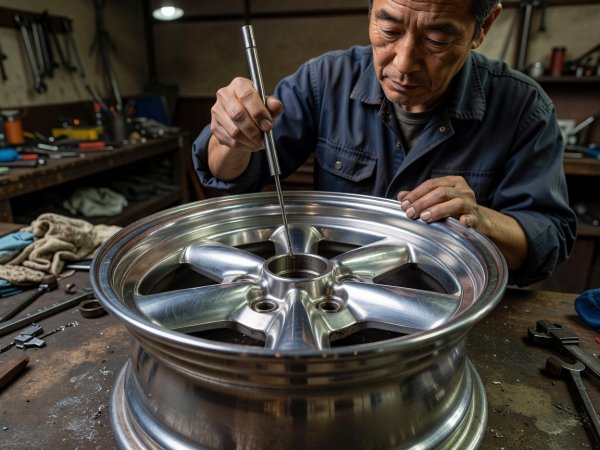
Japanese mechanic measuring the deep polished aluminum barrel of a 14-inch vintage four-spoke wheel ARCHETYPE 01 // KYUSHA 14-INCH

Small-Diameter Vintage Spun-Rim (13"–15")

Designed for pre-1989 Japanese coupes and sedans (such as the AE86 Corolla, Hakosuka Skyline, and Datsun 510). Small wheel diameters preserve period sidewall proportions while wide 8J to 10J barrels fill flared steel arches.

PCD: 4×114.3 | ICONIC FORMS: HAYASHI STREET, SSR MK-II/III, WATANABE
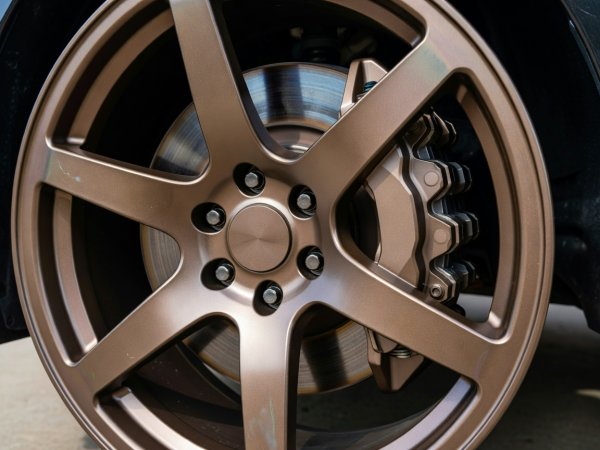
Close natural-light view of an anodized bronze forged 6-spoke wheel clearing a six-piston brake caliper ARCHETYPE 02 // MONOBLOCK TRACK

Concave Monoblock Forging (17"–19")

The benchmark of Kanto expressway, Taichung mountain-pass, and Bangkok street-performance builds. Features knurled bead seats that prevent high-grip radial tyres from slipping on the barrel under heavy braking.

FINISH: ANODIZED BRONZE / PRESSED GRAPHITE | WEIGHT: ~7.8–8.6 KG
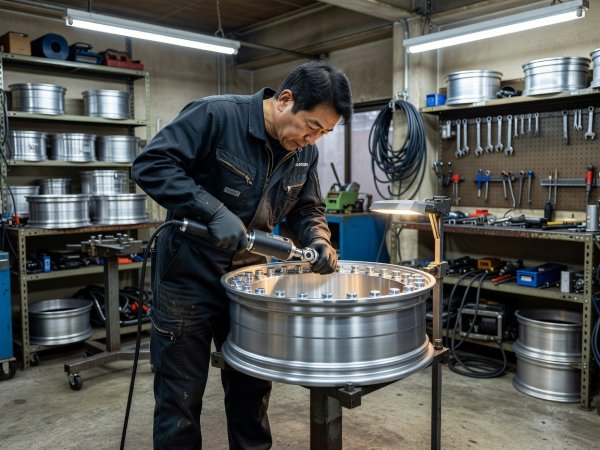
Technician in an Osaka wheel shop torqueing titanium assembly bolts on a three-piece step-lip rim ARCHETYPE 03 // 3-PIECE STEP-LIP

Modular Step-Lip & Reverse-Lip (18"–20")

Central to Bippu luxury sedans and tailored wide-body show builds. A stepped outer rim ("step-lip") increases structural rigidity against potholes compared to flat reverse lips while creating a layered metallic terrace.

DISK TYPES: HIGH / LOW / SUPER-LOW PAD | HARDWARE: 36-BOLT SEALED
GEOMETRY REFERENCE // UNDERSTANDING DISK & OFFSET

How Builders Calculate Pad Clearance & Scrub Radius

A frequent mistake among novice enthusiasts is assuming that two wheels sharing the exact same diameter, width, and offset—for example, 18×9.5J +22—will fit the same vehicle identically. In multi-piece Japanese wheel architecture, offset only describes the distance from the mounting hub pad to the centerline of the barrel; it does not describe the thickness of the mounting pad or the curvature of the spokes.

To solve this, manufacturers publish disk silhouette charts. On a vehicle with large four- or six-piston fixed front brake calipers, a builder specifies a High-Pad Disk (often designated Hyper Disk or R-Disk), which pushes the spoke face outward away from the caliper body at the cost of a slightly shallower outer lip. On the rear axle, where the brake caliper is smaller, the builder selects the exact same 18×9.5J +22 specification in a Super-Low-Pad Disk (O-Disk), yielding up to 35 mm of additional polished outer lip depth while maintaining identical outer fender alignment.