SECTION 01 // REGIONAL ARCHITECTURES

Local Scenes, Distinct Choices

Why a lowered executive sedan in Osaka, a composite-bodied pickup in Bangkok, and a restomod hatchback in Shah Alam answer entirely different environmental and cultural briefs.

VIEW REGIONAL MATRIX
REGION 01 // JAPAN (KANTO, KANSAI & CHUBU)

Metal Coachbuilding, Bippu Proportion & Kei Micro-Packaging

YOKOHAMA • OSAKA • NAGOYA

To flatten Japanese custom car culture into a single "JDM" label is to miss the intense regional specialization that defines the archipelago. In the Kanto plain surrounding Tokyo and Yokohama, expressway grand-tourers built for late-evening gatherings at Daikoku Parking Area prioritise high-speed aerodynamic balance. Builders pair wind-tunnel-informed undertrays, carbon rear diffusers, and functional brake cooling ducts with factory-level panel gaps. Even when a vehicle’s track width is widened by 50 mm, Kanto metal-shapers often fabricate steel blister fenders that preserve the original OEM bumper-to-fender seam.

Travel west to Osaka and Hyogo in the Kansai region, and the visual vocabulary shifts toward two influential traditions: Bippu (VIP executive sedans) and compact high-revving circuit hatchbacks. Classic Bippu builds—rooted in platforms like the Nissan Cima (Y31/Y32) and Toyota Celsior (UCF10/20)—are exercises in mass and posture. Rather than brightly coloured aero wings, Bippu craft focuses on lengthening the visual nose through extended front lip spoilers, hand-Hammered steel arch radiusing to clear deep-rim three-piece wheels at low ride heights, and bespoke puddle lighting engineered into rocker panels.

Equally distinctive is Japan’s custom Kei-car scene. Restricted by law to a maximum length of 3,400 mm, width of 1,480 mm, and engine displacement of 660 cc, micro-vans (such as the Suzuki Every and Daihatsu Hijet) and roadsters (Honda S660, Daihatsu Copen) force designers to work with watchmaker precision. Because overhang allowances are minimal, customisers redesign headlamp bezels, grille apertures, and tailgates to transform a utilitarian delivery van into a scaled-down overland rig or vintage sixties micro-bus without breaching the statutory dimensional box.

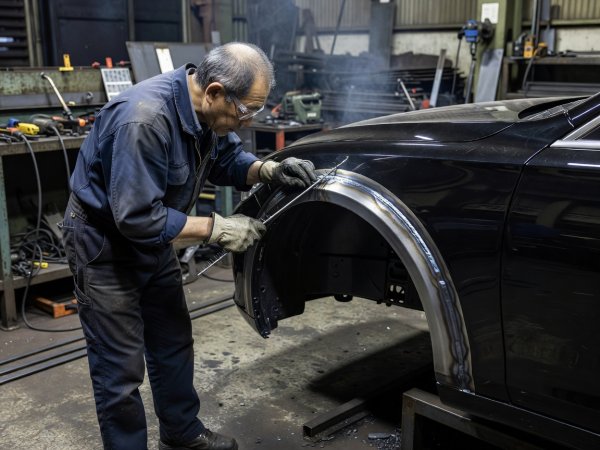
Metal craftsman in Osaka checking the contour of a hand-welded steel wheel arch on a black luxury sedan KANSAI // STEEL ARCH CRAFT

Arch Radiusing (Archi-Age)

On long-wheelbase sedans, raising the metal wheel opening by 20 mm allows the body sill to sit parallel to the asphalt without burying the top half of the rim inside the quarter panel.

TECHNIQUE: TIG-WELDED 1.2 MM STEEL + TIN LEADING
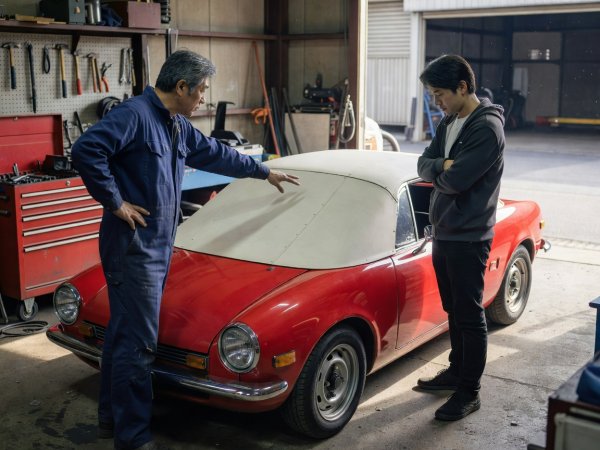
Two owners in Nagoya examining a custom fiberglass fastback hardtop fitted to a compact 660cc roadster CHUBU // KEI FASTBACKS

Micro-Scale Fastback Rooflines

Removable FRP and carbon hardtops turn two-seat 660 cc convertibles into Kamm-tail coupes, improving highway acoustic comfort while remaining within legal Kei exterior envelopes.

ENVELOPE: ≤ 3,400 MM LENGTH × 1,480 MM WIDTH
REGION 02 // THAILAND & MALAYSIA

Southeast Asian Utility Synthesis & Tropical Restomods

BANGKOK • PATHUM THANI • SHAH ALAM

In Bangkok and surrounding Pathum Thani province, the undisputed centrepiece of indigenous custom design is the lowered high-output common-rail diesel pickup. Because Thailand serves as the global manufacturing hub for one-ton trucks—producing millions of Isuzu D-Max, Toyota Hilux Revo, and Mitsubishi Triton units—local aftermarket workshops enjoy direct access to tooling engineers, composite autoclave technicians, and CNC machinists.

Thai builders approach the pickup truck with the same material discipline Europeans apply to mid-engine sports cars. Heavy stamped-steel tailgates, front doors, and hoods are replaced with translucent-clear-coated carbon-Kevlar panels featuring distinctive coloured hybrid weaves. Underneath the cab, leaf-spring rear ends are frequently re-engineered with four-link coilover geometry and billet aluminum trailing arms anodized in warm bronze or copper tones. Inside the engine bay, TIG-welded titanium intercooler piping with artisanal lobster-back ("pie-cut") bends serves as both functional high-boost plumbing and visual sculpture.

South across the border in Malaysia’s Klang Valley (Kuala Lumpur, Petaling Jaya, and Shah Alam) and in Singapore, custom culture revolves around multi-generational preservation and "OEM+ Tropical Restomods." Enthusiasts meticulously restore 1980s and 1990s Proton Saga, Satria GTi, and classic Japanese saloons. Because equatorial ultraviolet radiation and year-round 80% humidity rapidly degrade vintage plastics, builders combine period-correct exterior decals and gravel-spec rally mudflaps with modern ceramic window films, upgraded aluminum radiators, and programmable standalone engine management.

1.84 Million Total motor vehicles produced in Thailand in 2023, led by 1-ton pickup platforms that anchor local custom workshops. SOURCE: FEDERATION OF THAI INDUSTRIES (FTI)
40,000+ Attendees Annual visitor turnout at Malaysia’s Art of Speed exhibition at MAEPS Serdang celebrating custom coachwork. SOURCE: ART OF SPEED MALAYSIA
Grade 2 Titanium Standard 1.0–1.2 mm wall tubing used by Bangkok fabricators for lightweight pie-cut charge piping. SOURCE: PATHUM THANI FABRICATION GUILD
REGION 03 // SOUTH KOREA & TAIWAN

Parametric EV Surfacing & Mountain-Pass Grand Touring

SEOUL • INCHEON • TAIPEI • TAICHUNG

South Korea’s tuning and customisation landscape has transformed rapidly following the revision of national vehicle tuning regulations by the Ministry of Land, Infrastructure and Transport (MOLIT) and the certification framework managed by the Korea Transportation Safety Authority (KATRI). In Seoul, Incheon, and Yongin, design studios leverage the country’s powerhouse digital-modelling talent to craft aerodynamic body programs for modern fastbacks and electric vehicles such as the Hyundai Ioniq 5 N, Kia EV6, and Genesis G70.

Korean custom aesthetics emphasise sharp, faceted plane changes—often echoed in pixel-inspired LED DRL housings and CNC-machined aero flicks—that mirror Seoul’s contemporary architecture. Because modern EVs carry substantial battery mass low in the chassis, Korean builders focus on brake thermal management (upgrading to 6-piston monoblock calipers behind directional vented wheels) and flat-bottom aerodynamic diffusers that preserve highway range.

In Taiwan, centered around Taipei, Taoyuan, and the precision manufacturing belt of Taichung, custom builds are shaped by the island’s dramatic topography. Within thirty minutes of urban Taipei lie steep, switchback mountain roads (such as Yangmingshan and Route 9 through Pinglin). Consequently, Taiwanese builds—often based on sports wagons and Euro-Asian touring sedans—favour generous suspension travel, two-way adjustable remote-reservoir dampers, and high-clearance forged wheels originating from Taichung’s world-renowned aluminum forging plants.

Regional Asian Custom Automotive Design Matrix
Region / Hub Signature Base Platforms Dominant Material Craft Regulatory & Environmental Driver
Kanto & Kansai, Japan Executive Sedans (UCF/JZS), 660cc Kei Vans & Coupes TIG-welded steel arch radiusing, multi-stage lacquer Biennial Shaken inspection (90 mm clearance) & Kei size cap
Bangkok, Thailand 1-Ton Spacecab Pickups (D-Max, Hilux), Eco-Hatchbacks Autoclave carbon-Kevlar doors, pie-cut titanium piping Commercial pickup excise structure & local composite tooling
Klang Valley, Malaysia Proton Saga/Satria, 1990s Compact Saloons OEM+ heritage trim restoration, tropical thermal glazing Equatorial UV/monsoon durability & national compact heritage
Seoul & Gyeonggi, Korea Performance EVs (Ioniq 5 N, EV6), Turbo Fastbacks 3D blue-laser scanned ABS aero kits, parametric lighting KATRI parts certification & high-voltage EV aerodynamics
Taipei & Taichung, Taiwan Performance Wagons, Compact Touge Coupes Taichung 6061-T6 forged wheels, remote-reservoir coilovers Steep mountain-pass (Yangmingshan) suspension compliance